
The Charles Dickens Museum in London
Photo by Literary Photographer / Literary News
LONDON, UK – Most visitors are lured by London’s pageantry and architecture: Big Ben, the Tower of London and Parliament. But there’s more. London treasures genius. Where else could a fictional creation — Sherlock Holmes — have an actual residence built for him at 221B Baker Street? London is where Peter Pan found Wendy, where Oliver Twist met the Artful Dodger. So, forget the royal scandals, London’s best export is its writers.
These six London neighborhoods house Britain’s literary history.
Bloomsbury – Two words: Bloomsbury Group. A collection of writers and artists put this bohemian neighborhood on the map in the 1920. Besides swapping ideas and occasionally partners, Virginia Woolf, Duncan Grant and Clive Bell, among others, did their best to shake up stodgy Victorian society. The Woolfs set up the Hogarth Press in their basement at 52 Tavistock Square, then unleashed the first edition of T.S. Eliot’s The Waste Land and three of Virginia’s most famous novels on a stunned public.
Mystery writer Dorothy L. Sayers moved to 24 Great James Street in 1921, where she wrote her acclaimed Lord Peter Wimsey mysteries. Lord Peter scandalized society by meeting his future wife, feminist Harriet Vane, at her murder trial. She lived at 100 Doughty St., while No. 48 housed Charles Dickens, who penned Nicholas Nickelby and Oliver Twist. His home is now the Charles Dickens Museum, dickensmuseum.com/, open Wednesday-Sunday. The current “Extra/Ordinary Women” exhibit, running through Sept. 6. showcases the real women. Some even have fictional counterparts.
And don’t miss the British Museum’s Reading Room, where Karl Marx, Oscar Wilde, and Virginia Woolf once worked. That’s not possible now, but guided tours are. The stunning reading room houses 25,000 books, catalogs and printed material. The museum is free. Great Russell St, London WC1B
Chelsea – E.M. Forster in Howard’s End mentions “long-haired Chelsea,” which, like Greenwich Village, courted eccentrics. The poet/painter Dante Gabriel Rossetti lived in Chelsea between 1862-1882. Rossetti was noted for his wild parties —which upset his well-heeled neighbors. Rossetti wasn’t the area’s only rebel.
In 1884, Oscar Wilde bought 16 (now 34) Tite Street. Nine years later, he left his wife and moved to the Savoy Hotel. By then, his affair with Lord Alfred Douglas was a cause célèbre. While Wilde outraged society, Bram Stoker terrified it. He lived at 18 St. Leonard’s Terrace and published Dracula in 1897. And classy 4 Cheyne Walk was the final home of George Eliot, who wrote Silas Marner and Middlemarch.
Hampstead – A lovely North London neighborhood, Hampstead is home to Georgian houses and Hampstead Health, 800 acres of woodland that offer a panoramic view of the city. The Romantic poet John Keats spent most of his working life, 1818-1820, at Wentworth Place. “Ode to a Nightingale” was written under a plum tree in his front garden, which fans can now visit. Keats House Wentworth Place, NW3. Open Wed-Sunday
Supposedly, one of George IV’s eccentric admirals also lived nearby in Admiral’s House, remembered in P.L. Travers’ enduring children’s classic Mary Poppins. Travers wrote the novel at 50 Smith St. in Chelsea.
Mayfair – This pedigree postal code has long been a breeding ground for notables. Dorian Gray, the notorious figure in Oscar Wilde’s only novel, “The Picture of Dorian Gray,” lived in Grosvenor Square. Wilde bought his buttonholes in the Burlington Arcade and lunched daily at the Café Royal in Regent Street, often bringing his rent boys, or what he called “feasting with panthers.” Posh Mayfair is also home to several beloved fictional characters. Lord Peter Wimsey had digs at 110 Piccadilly overlooking Green Park, while Margery Allingham’s 1930s private eye Albert Campion lived above a police station in Bottle Street. P.G. Wodehouse’s man-about-town Bertie Wooster resided at swanky 6A Berkely Mansions with his gentleman’s gentleman, the inimitable Jeeves.
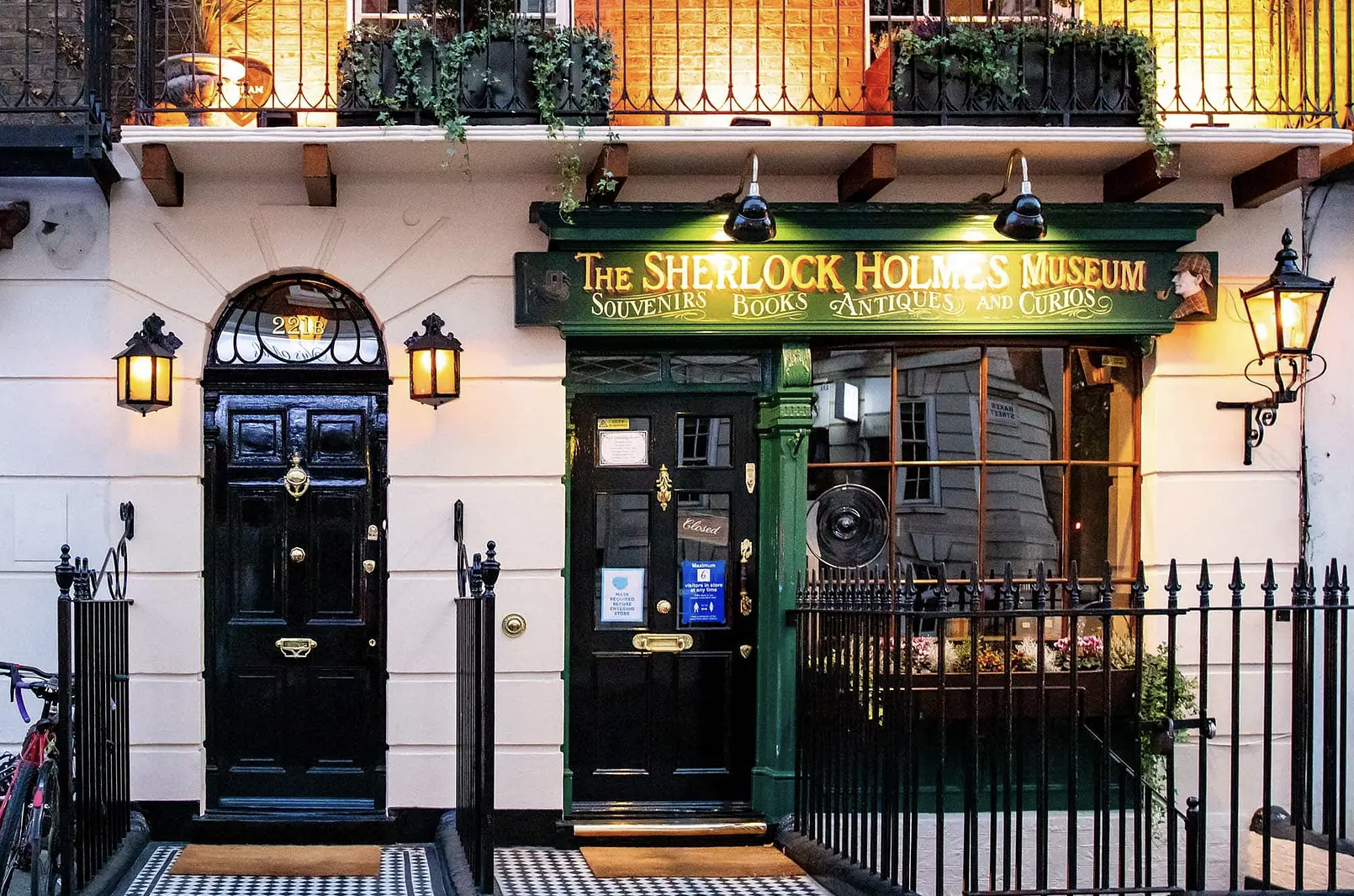
The Sherlock Holmes Museum at 221B Baker Street, London
North London – No literary tour of London is complete without a stop at The Sherlock Holmes Museum, 221b Baker Street, NW1. Rooms have been recreated to look as they did in Victorian times, when Sherlock Holmes lived here, 1881-1904. The four-story Georgian townhouse dates back to 1815. Open daily. The great detective observed: “Truth is stranger than fiction.” This gloriously constructed homage is a reminder that life imitates art.
Bankside – Everyone’s heard of the playwright William Shakespeare, who penned Romeo and Juliet, Hamlet and Macbeth. His legend is celebrated in Stratford-upon-Avon, where he was born and lived. But his works are performed at London’s Globe Theatre, 21 New Globe Walk, SE1 near the Tate Modern museum. The Tempest is on stage through April 12.